Thursday, November 26, 2015

Chongqing

Chongqing, also known as the Mountain City, is a metropolis built around the confluence of the Jialing and Yangtze rivers in west-central China. It was part of Sichuan until 1997, when the government split it off into a separate province due to its enormous population. 

Last Friday at 7:45am I took the bullet train from Chengdu. I took turns dozing and watching the terraced hillsides go by in a blur, the only sound in the train an advertisement for dried lean beef strips, playing on repeat. The train ride used to take 12 hours, but now the high speed rail gets there in two hours. 

In front of the train station there was a bus to the monorail station. The monorail took me to a subway. From the subway station I took an escalator up and found myself in a shopping mall, still three floors below ground. I went up to the ground level, went outside, and reviewed the directions to the hostel on my phone.

Go to the third floor of the shopping mall and exit the door near the wedding banquet hall, said the directions.

I went back inside, up three more flights of escalator, and found the wedding banquet hall. Next to it there was another door that led to a street (the kind you can walk on, etc.).

Take a left, go into the Taiwanese karaoke parlor, and take the elevator to the eighth floor, read the next step in the directions.

I walked through the sparkly gold lobby and into a glass elevator. We were already on the third floor. The fourth through seventh floors looked like typical apartment building hallways, but on the eighth floor the door opened onto a park. 

Go through the park and into the first building on the right, said the instructions. 

The hostel was an apartment on the 35th floor to which some extra bunk beds had been added. I had one roommate, a Singaporean named Sherman, who had bleached hair and all white clothes and wore toe socks and toe shoes. He said he used to be a world music composer, but now he was writing a novel instead.

"Small noodles" (小麵) with a fried egg, a common Chongqing street snack. The sauce has the "málà" spicy-numbing flavor combination characteristic of Sichuanese hot pot. 

Savory tofu pudding (豆花). You take a piece and dip it in the spicy garlic-sesame sauce and then eat it.

Downtown Chongqing at night. The small tower in the middle with the dome was the tallest building in Chongqing when it was built; now it's possibly the shortest.


This and below: The Hongyadong (洪崖洞, literally "Flood Cliff Cave"), a big old complex on the banks of the Jialing river.


Where the Jialing river meets the Yangtze, seen from outside the Hongyadong.

Sauces for sale in the Hongyadong.

In my apartment at 6:02 I hear an ice cream truck version of Für Elise start outside. I grab the blue plastic bag from the trash can, tie it up, kick on my flip-flops, and run downstairs. Outside, people carrying bags of the same color and widely varying sizes are converging from all directions on the truck, which is parked down the street. Actually, there are two trucks -- a big garbage truck and a smaller pickup behind it. We throw our blue bags into the big one and watch them get compressed by the metal door. There are big plastic tubs set behind it where people dump their compost and restaurant workers take turns pouring a day's worth of leftovers. The compost truck takes my empty water and yogurt bottles. I notice some people putting their bottles in a separate heap nearby, which is being watched over by an old woman. She tells me she's a private recycling enterprise. Noticing that some people put their recycling in the pickup while others choose her pile, I ask her what the practical difference is. She shrugs.

Tuesday, November 3, 2015

The internet already has enough postcard pictures of places like Hong Kong on it. That's my excuse for not posting any good photos. 

It was a two-hour flight from drizzling, cool Taipei to sunny, humid Hong Kong. Then a 45-minute bus ride from the airport to a bus stop right in front of the hostel near the south tip of Kowloon. The hostel is in the Comfort Building, a thin wedge between two bigger commercial units in one of the big buildings that take up whole blocks and almost feel like cities unto themselves. 

To get to the hostel, I walked down the narrow hallway and crammed into a small elevator that was just big enough for two other people plus me and my backpack, and went to the sixth floor. The sixth floor of this sliver of building was in turn partitioned into six units. Opening the door of the hostel partition, I was greeted by an empty desk with a long, narrow hallway behind it.

I walked down the hallway and found a TV, a refrigerator, and an empty bottle of Macallan 12 year, but no people. I had the contact info for the host, a mysterious entity known by the moniker Tabi88. I texted them that I'd arrived. The reply came almost immediately.

I can see you're in the common room.

I looked around and saw a camera on the ceiling down the hall, pointed at me. 

Your room is to your left, bed #0. 

Thanks, I texted back, realizing I was never going to meet or find out anything about this Tabi88 entity. 


The view west out the window of Tiger Curry, a cafe that specializes in Japanese style curry pasta and cheesecake. It's in one of the numerous expensive-looking shopping malls that line the west side of Kowloon.


Fish balls ("fish eggs") and fish slices in egg noodle soup.


Near the hostel

Friday, October 30, 2015

7-Eleven, Mr. He, and New Foods


There's a sports center with a gym not far from my apartment where I usually go for exercise. Afterward, I typically go to 7-Eleven for soy milk, a tea egg, and an onigiri.

As an aside, 7-Elevens in Taiwan are the opposite of 7-Elevens in the States. The version in the States, of course, is best known for its 48oz. Slurpees and food items made primarily from leftover industrial waste and discarded cattle feed, which can hospitalize an otherwise healthy person if eaten in any significant quantity. That's about all it has to offer.

The version in Taiwan is different. For one thing, it sells items that resemble real food: sandwiches, pasta, onigiri, almond slivers with tiny dried fish, the aforementioned tea eggs. It's still all laced with preservatives, and it's still a minefield of industrial sludge shaped like potato chips, but the point is that things with nutritional value can be had.

Then there's everything else: the clean bathrooms (again, no need to buy anything to use one), the ATMs (no transaction fee), the clean, bright seating areas inside and outside, the free WiFi, and the all-purpose vending machines, where you can buy things like plane tickets, train tickets, bus tickets, and concert tickets, print out contracts, get a passport photo taken, make photocopies, deliver or receive packages, or do pretty much anything else that would otherwise require you to go to some specialized place that does only one of those things. I'm pretty sure they also print wedding certificates, though I haven't tried.

So usually I go there for my post-exercise snack. For the sake of variety, however, today I went to the lunch cafeteria next door. It was in a small shack that looked like it was caving in. A couple people who had just ordered were waiting outside the open entrance, and a woman with an apron was standing over a cart with two cauldrons of hot liquid. I ordered a shrimp fried rice and the woman told me to sit, nodding in the direction of the door of the adjacent building.

Inside was a long room of tables with people eating. Every seat was taken except for one table at the back, where an old man was sitting by himself, facing the wall. I sat down across from him.

He looked up and smiled at me, revealing long, crooked, discolored teeth with several large gaps, and asked where I was from.

Mr. He (pronounced like "huh") is 70 and worked in real estate from high school straight until his retirement. He's one of nine children, eight of which are boys, and has five sons. He's been married and divorced twice, and now lives with his girlfriend of 18 years. His dream is to travel around the world, but he's afraid of flying and so has only been as far as Korea and Japan.

Why don't you take a boat? I offered. You still look plenty young to travel the world.

Thank you, he said. You've comforted me.

He asked me how old I was, and when I told him he nodded approvingly and laughed. Good! He reached into a bag and produced a seaweed snack, which he offered to me. Then he pointed at his teeth and laughed again.

You don't brush your teeth? I ventured.

Five times a day! he replied. He reached into the bag again and produced a toothbrush and rinsing cup to prove it.

Maybe that's a few too many times, I caught myself thinking.

Mr. He took his phone out of his pocket and showed me a video of cats in a cage.

These are my cats, he said. I have twelve cats, and two dogs.

I wanted to ask why they were all in cages, but thought better of it. We exchanged phone numbers, and wished each other the best of luck.


These are dishes I had last night at a 熱炒 ("Hot fry") restaurant. Clockwise, from top-right: Birds-nest fern with small dried fish; Deep-fried oysters and basil; Sweet and sour Asian swamp eel; Whole squid with ginger; Basil omelet. Not pictured but consumed: Deep fried, breaded pineapple shrimp balls with frosting and rainbow sprinkles on top.


A chandelier store, I assume.


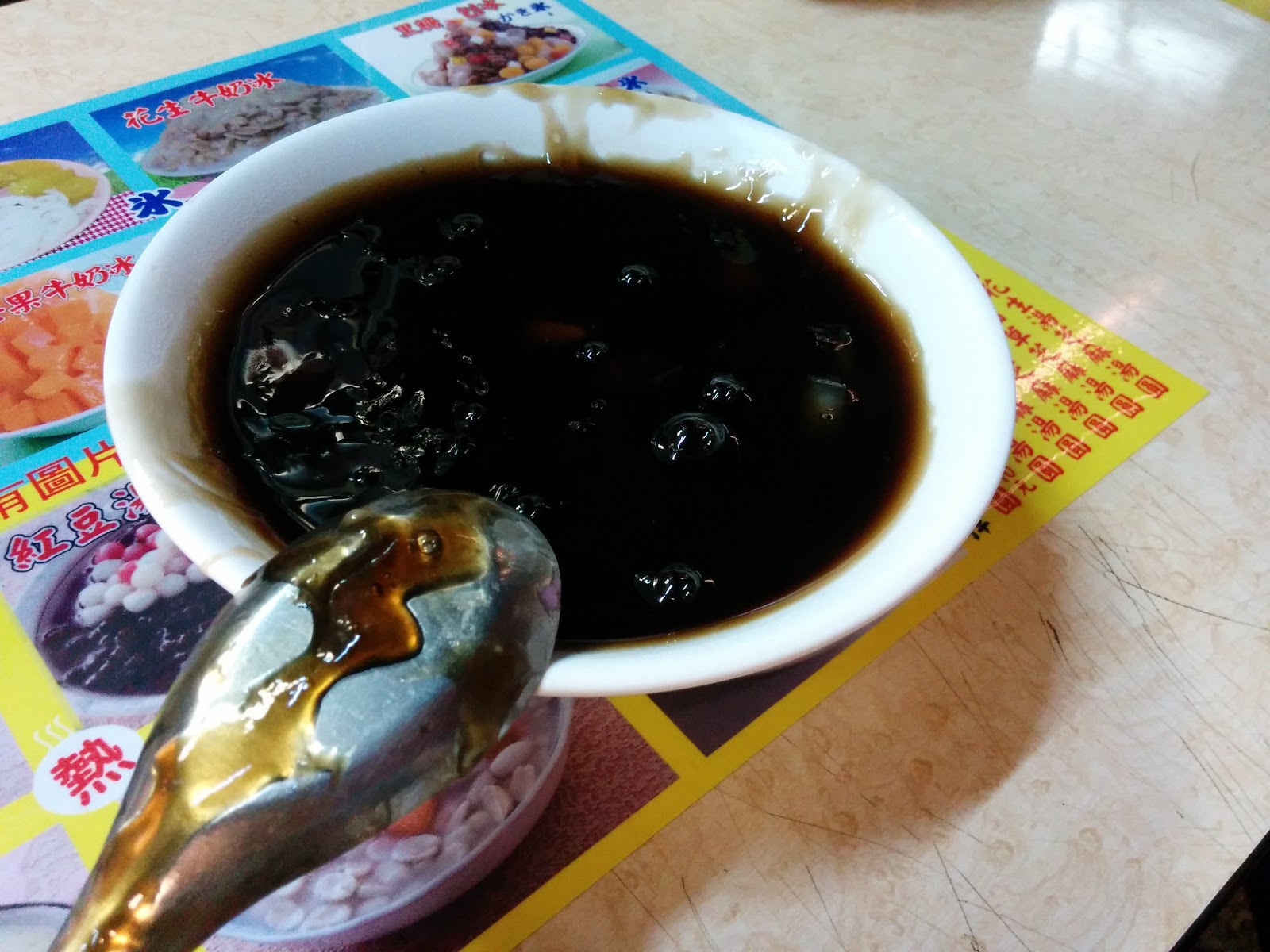
This gloopy dessert, which I had two nights ago at the 寧夏 night market, is made from grass jelly (仙草). Inside, hidden in the jelly, are fun things like boiled balls of glutinous rice flour (湯圓) and pinto beans. Another dessert I had here, which was even more of a gastronomical revelation, is a pungent, sweet and sour, pinkish soup made from fermented rice (I'm pretty sure it's made with koji). The version I had contained large glutinous rice flour balls stuffed with sweet black sesame paste. I was so excited about this that I forgot to take a picture.


The entrance of a temple.

Tuesday, October 27, 2015

This past weekend I went to Taichung (台中). Here are some photos and episodes from that trip. 


A karaoke house in Taichung. The night special lets you sing from 11pm until 8am, and includes a buffet with things like noodles, miso soup, porridge, and ice cream. 


萬能青年旅店 playing to a packed house at TADA方舟 in Taichung.


Downtown 台中.


Square in front of the Science Museum.


Fish and onions with deep-fried soybean paste granules.


Taichung's annual international jazz festival. This is one of several stages scattered throughout the city parks. 


These four pictures are from the coffeehouse I stayed at, 艸田空間 ("Grass Field Space"). Run by three artists and longtime residents of Taichung, it's actually more like a community center than just a coffeehouse. Two of the artists, Ahuan and Xiaolian, live in the rooms behind Grass Field Space. While I was there, friends were constantly coming and going.

On Saturday night they invited two local farmers to come and talk about the problems with industrial eggs and chicken, and the difficulties with small-scale, traditional farming. I was at the jazz festival that night and when I got back around 10pm the presentation was already over, but people was still talking in the living room. They talked about slaughterhouses, raising goats and the need to keep them separated to avoid a critical mass that would lead to violence, and of course the ethics of killing other animals, on which topic everyone seemed to have a different perspective. I had a hard time following the discussion after that, partly because I was tired and partly because it seemed to be getting more and more abstract as the night went on. Around 2am everyone else moved to the patio and I fell asleep on the living room couch to the sound of voices and the occasional snap of the mosquito zapper.

The next morning at about 11 I woke up to a low chime sound and the smell of frying butter. Xuezong, who runs 松竹本部 ("Pine Bamboo Headquarters"), a teahouse he opened together with the artists at Grass Field Space, was sitting on the patio in the same spot where I'd last seen him the night before. Another friend, a pharmacist who had just come back from Germany, was asleep on the floor in the living room. Xiaolian and Ahuan were carrying plates of vegetables, beans, seitan, omelets, and rice porridge with pumpkin slices to the patio table.

While we ate we talked about crop circles. Ahuan showed me a picture of a crop circle from Brazil that looked like a big spiral with a smaller baseball next to it.

The spiral is the world, and that's the motor, he said, pointing to the baseball.

I asked him how he knew it was a motor. He pulled up a YouTube video of a three-dimensional yin and yang construction. It started with two flat circles, and then lines started filling in the space between them. At one point Ahuan pointed -- there! -- and it did indeed look like the same shape. He explained that the yin and yang shape and this motor design are just two dimensional representations of a black hole.


After breakfast, five of us went to a warehouse in the alley behind the coffeehouse. They had bought this building recently and were using it temporarily as a storage space for the materials and props they needed to run an annual music festival, the first of which was last February. All the buildings they used during last year's festival they had built themselves with these materials, which appeared to be mostly scrap lumber and dilapidated furniture.

A few of us climbed up an unfinished staircase and stepped into the loft, completely filled with boxes except for a narrow uneven walkway and a small room in the back with bedding and a mosquito net.

Guests sometimes stay here, Xuezong informed me.

From the loft, we climbed up a wobbly metal staircase lined with thin, nailed-together plywood, and came up to the roof. The roof had another structure built on top of it, made mostly from tied-together bamboo and corrugated metal. Again, it was mostly full of boxes and furniture, and at one end there was another empty room with bedding and a mosquito net.

Ahuan built all this, Xuezong said. People often ask him how he learned all this stuff. He always tells them that humans originally have the ability to build shelter. But we didn't learn any of it in school, so now we have to teach ourselves.

We made our way up a narrow cardboard ramp into the DIY roof structure, careful not to prick ourselves on the nails sticking out of the plywood railing. In the front there was a balcony with a charcoal grill, looking new in comparison to everything else. Xuezong was hauling another box up from the street below, using a thick rope.

There's no place to put it! he shouted down to Ahuan, shoving it into a corner.

As we climbed carefully back down, Xuezong told me they were going to turn this place into a performance venue.

We just need to take care of all this stuff first, he said.

Looking at the boxes behind chairs behind broken pianos behind stacks of paper behind more boxes, I asked how they could be so calm in the face of such a great task.

We wait until it's sunny and we're feeling good before doing any work, Ahuan told me, beaming.


These two pictures are from Pine Bamboo Headquarters, the teahouse. Most of the furniture, the cabinets, and the bar itself were either salvaged or made from salvaged materials by Ahuan, Xuezong, and friends.

The space has housed poetry readings, a pickled plum workshop, and other events. The menu consists of a few kinds of black tea grown in 日月潭 ("Sun Moon Lake", where I happened to be a few weeks ago -- post forthcoming) and a sandwich. Xuezong is teaching himself how to make Japanese snacks so he can expand the food menu.


Thursday, October 15, 2015

Typhoon, part 3

Typhoon post #1
Typhoon post #2

I ended the last post with "to be continued..." but that was really the end of the story. Later that day I bought a thin mattress and sheets, a water filter and an electric kettle. As a housewarming present, Mr. Song gave me some tea, a pomelo, a mooncake, a pineapple cake, a small knife, a bar of soap, and a coffee mug.

Since then I've had a few weeks to explore the neighborhood. There's an air-conditioned cafe down the street that serves good espressos in absurd espresso cups.

Good espresso in absurd cups 

Most of the storefronts on the main road where I live are motorcycle or car mechanics, parts dealers, or car dealerships. There's a betel nut shop across the street, frequented by truckers. Next to my building there's a plant nursery, the restaurant where I got the noodles that tided me over during the typhoon, an adult video store, a kindergarten, a guitar shop, and a pet store. Of the four gray kittens in the window display cage, two are always fighting, and one sleeps in the litter box. The last one stands to the side, staring into space.


On the opposite side of the street to the east, behind the buildings, there's a big green hill. In the morning the sun rises over the hill and sends light into the sun balcony, down the hall, through the small window into my room. A little before noon my room gets darker, but in the afternoon on clear days the sun reflects off the buildings and comes through the window again.


The other day I decided to block the light coming into the window by putting up a curtain. There's no rail to hang a curtain from, but I had some pushpins I got at the local stationery store, so I just needed something to hang from them.

At first I thought if I kept my eyes open I would pass a fabric or curtain store eventually. When a few days of implementing this strategy full time produced no results, however, I gave up on it and took the bull by the horns. I used the internet.

It turns out there is a fabric district in Taipei, and all the fabric stores are there. Walking from Taipei Main Station, you first pass through the holiday-themed district -- witch hats, pumpkins, and sparkling skeleton cutouts cluttering the window displays -- then an old brick art museum, then a no man's land of convenience stores, and you finally come to an intersection where all the stores sell fabric.

I bought a big square piece of light blue fabric at the first shop I went to, and went back to the train station for dinner.

Coffee, Teatime & Goodtime. Pasta, Pizza & Cutty heart. 

Don't forget the gas pump. 


I went to the Chinese medicine doctor a couple weeks ago to ask about my digestion, which hasn't been optimal since I came back from China five years ago (Aspiring Adventurers: don't let that scare you -- just make sure you have a vibrant gut culture before you go). The doctor gave me some brown, dusty medicine (to be taken with water three times a day before meals), and said to avoid coffee, tea, bread, steamed buns, pears, pineapples, lemons, bean products, sweets and cakes, anything pickled, dairy, guava, lotus roots, and jujubes. 

She looked surprised when I asked her what was left. 

Rice, she reminded me. Green vegetables! Meat! 

Oh. Right.

Recently I've been eating a lot of Japanese food.

Dinner at Taipei Main Station. Comes with bottomless rice and miso soup.

Fried rice with "cherry blossom shrimp" and salmon

Wednesday, October 7, 2015

Typhoon, continued (first part here).

Upstairs again with sesame noodles in hand, I resumed sitting on the bed frame, watching Mr. Song clean out the desk drawers. I told him I didn't think I would have a chance to go get a mattress that evening.

No problem! he said, and went to the next room, coming back with a big red blanket. He draped the blanket over the bed frame.

You can sleep on this tonight, he said. Though I'm afraid it might be too hard for you.

Not at all, I said. It's perfect. Then the power went out.

I spent the night turning over on the red blanket-draped bed frame, listening to the loose window above me clatter with every gust of wind, blearily wondering if the next gust would be strong enough to dislodge it from the frame and drop it on my head.

In the middle of the night I woke up to silence. I went out to the balcony, and the debris-filled streets were dark and quiet. The trees still looked a bit bent, like they were unsure whether it was safe to stand up straight again. I went back to the room, propping my hip bone under my travel neck pillow and going into another dreamless half-sleep.

Around 8am the clattering window woke me up again. Outside the rain had stopped but the wind was howling. I opened the door to find Mr. Song pacing the hall, carrying things from one room to another. He'd spent the night in the next room with all the stuff he'd cleared out from mine the day before, and now he was moving it to the foyer.

A guest was coming to look at the other room that afternoon, so he would be staying here today to wait for them, he said. I spent the next hour unpacking my things and scrubbing the walls.

By 9 o'clock the wind had almost disappeared again. Mr. Song knocked on my door, asking if I wanted to go find breakfast. Thinking of my leftover sesame noodles in the fridge, I told him I was interested.

Downstairs at the bottom of the stairwell under the concrete stairs were three bikes. We propped the door open and I helped him move the first one outside.

This one is a lady bike, he said. It doesn't work, but we keep it here.

We took the two remaining bikes outside, and put the lady bike back in its place.

As we rode down the back streets behind the building, Mr. Song introduced me to the neighborhood.

This was a great place to raise kids, he said. Our son went to that elementary school. This breakfast place has been here for 30 years. Western style, Chinese style, they can make everything, he said, pointing to another closed garage door.

We went down a ramp toward the river, and found our tires submerged in mud and silt. At this point breaking would have meant falling over, or at least getting mud all over our shoes, so we kept pedaling precariously forward.

This path goes all along the river for miles, Mr. Song said, sweeping his arm over what looked like a dried up creek bed. I always ride here in the evening. We turned and rode along this creek bed, passing overturned signs, uprooted shrubs, and displaced concrete barriers. Every now and then the actual paved path showed itself from under the sand.

A few other people were walking down the path, mostly going in the opposite direction. We passed a teenager standing forlornly on a motionless skateboard, wheels sunk halfway into the mud. Some older people were wading in a ditch with nets, scooping up large fish. I asked Mr. Song what they were doing.

They're catching those fish as pets, he replied. You can't buy this kind of fish at the pet store.

The path was also littered with the carcasses of many more of these same fish, which looked a little like carp. Under the bridge, some elder ladies had gathered a lot of them into a pile.

We rode along with the river on one side, and a huge concrete wall on the other, with regular staircases leading up and over it to the city. Each staircase was blocked halfway up by a snarl of tree branches and shrubbery.

There's a gate up ahead that goes back to the road, Mr. Song said.

When we got to the gate, the sturdy metal door was shut.

It's OK, there's another one farther up, he said.

The next gate was closed too. I started to wonder why we hadn't seen any other bicyclists on the path yet. We rode for a while in silence, passing more and more dead fish lying pristinely on the pavement. Had the flies all been blown away by the storm?

I wasn't planning on biking this far, Mr. Song said finally.

We kept moving forward, and then we came to a bend in the river where the path sloped upward and eventually led over the wall and back to the street.

To be continued...

The path by the river during evening (a week after the typhoon)

The wall on the river side

 Mobile theater and temple on the opposite side of the wall from the river

Squid stew (猶豫羹) 

Vegetable dumplings with sides of seaweed and dried tofu with tiny crispy fish